Editor’s Note: This article was originally published in 2012, detailing Festo’s innovative SmartInversion, a unique flying machine propelled entirely by the kinematic principle of inversion.
Festo, a highly innovative German automation technology company that famously brought us the incredibly lifelike SmartBird robotic seagull and bionic flying penguins, has built a radically different flying paper aircraft unlike absolutely any we have ever seen, and it is entirely propelled by a fascinating inversion mechanism.
The Magic of Inversion Kinematics
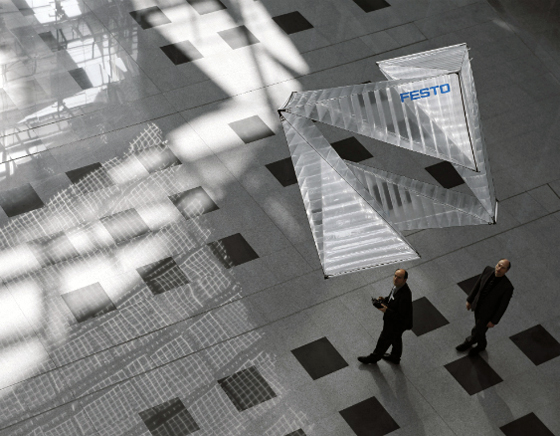
Loosely based on a complex geometrical band originally created by Swiss artist and clever inventor Paul Schatz, the SmartInversion is filled with lighter-than-air helium and smoothly propels itself straight through the air by constantly and rhythmically turning itself completely inside out.
The SmartInversion, officially described by Festo engineers as an “airborne geometrical band with inversion drive,” is definitely going to look very familiar to anyone who has ever played with a fairly popular origami paper design that can be continually twisted inwards or outwards while it magically shows different painted sides of the tetrahedral shapes it is made of.
A Giant Helium Origami
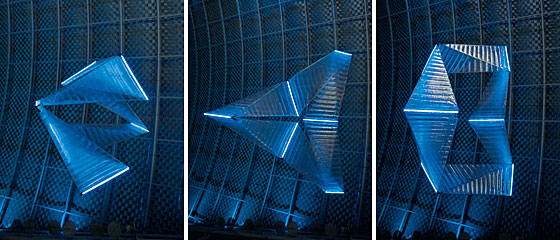
This giant, mesmerising piece of high-tech origami is meticulously composed of selectively-linked, extremely lightweight tetrahedron-shaped compartments, each carefully filled with helium gas. Precisely operated by tiny electric actuators, it intelligently uses complex inversion kinetics to gently propel the entire contraption smoothly forwards.
It’s essentially a six-sided, fully articulated ring of distinct prisms that attaches perfectly to form a cube, and when it’s finally unleashed, it can smoothly start folding into entirely new geometric shapes in the process. As it constantly turns itself inside out, it actually moves forward. This deeply pulsating and highly rhythmical property of kinematics is officially called inversion.
Future Applications
Working deeply with the unique geometrical band, Schatz originally discovered that the core principle of kinematics, which until then had been almost entirely based strictly on standard rotation and translation (linear motion), could absolutely be extended by a major further mode: inversion.
Festo’s main engineering goal is to “investigate the fascinating phenomenon of inversion in much greater depth”. The brilliant designers at Festo, also incredibly well known for their heavily nature-inspired robots, are now actively sponsoring a large competition for university students to quickly figure out some highly practical, real-world uses for this amazing thing.
