Editor’s Note: This article was originally published in August 2012, documenting the historic landing of NASA’s Curiosity rover on Mars.
The highly anticipated NASA Curiosity rover, after its initial launch on 26 November 2011, has now finally landed safely directly on the surface of Mars after a long, perilous voyage of roughly eight and a half months, safely covering a staggering 352 million miles. Curiosity is an advanced, fully nuclear-powered robotic rover specifically designed by NASA’s prestigious Mars Science Laboratory.
First Images and Reactions
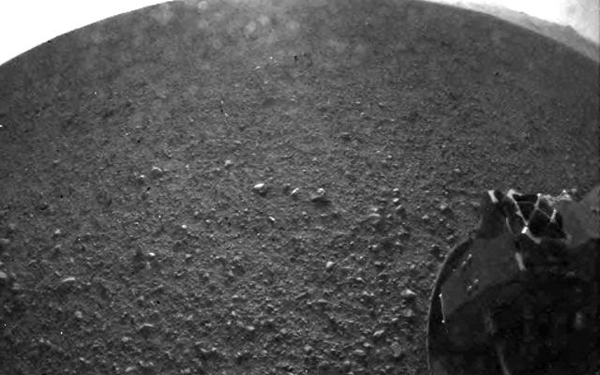
The robotic Curiosity rover quickly sent its very first image taken directly on the barren Martian surface, and the historic photo eventually became highly viral across the internet and television platforms worldwide. This particular image was actively taken by a special “fisheye” wide-angled lens of the built-in Hazard Avoidance camera securely mounted on the lower left-rear side of the Curiosity rover. The sensitive cameras are actively protected by a clear dust cover strictly during the violent landing sequence.
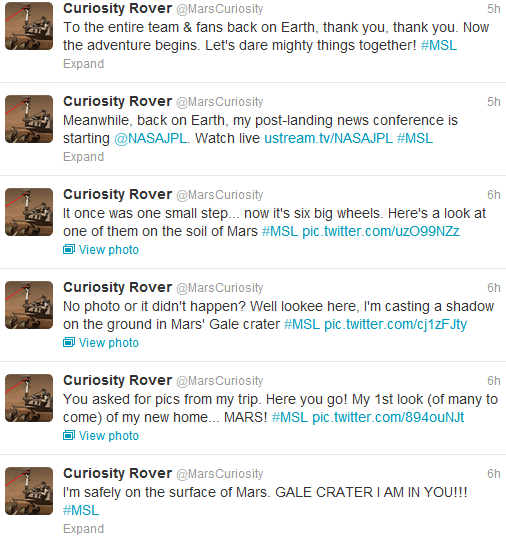
On its official Twitter account, Curiosity excitedly tweeted: “I’m safely on the surface of Mars. GALE CRATER I AM IN YOU!!!”.
Mission Goals and Equipment
Curiosity successfully landed on Aeolis Palus directly within the massive Gale Crater after a highly complex series of automated landing maneuvers. The primary main goal of Curiosity is to aggressively find out whether Mars could have actively supported microscopic life in the distant past and to thoroughly study the complex Martian atmosphere, shifting climate, and deep geology. This vital scientific information about Mars is heavily required in order to precisely make solid plans for future ambitious human missions to Mars.
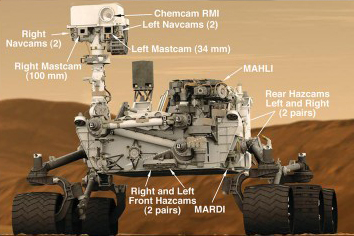
Curiosity actively carries numerous pieces of advanced scientific equipment to thoroughly research the alien Martian surface, carefully determining exact mineral compositions to actively find absolutely any hidden evidence whether primitive microbial life ever truly existed on Mars. It boldly features a robust robotic arm to deeply drill the rocky surface, a powerful laser that can safely scan target rocks from a far distance, and a sensitive radiation detector to carefully measure various dangerous cosmic radiation levels.
A Historic Achievement
NASA’s tense Pasadena mission control room joyously celebrated the incredibly successful safe landing of Curiosity. The impressive HiRISE orbital camera flawlessly shot an amazing aerial photo of the descending rover hanging from its massive parachute directly during the final landing phase.
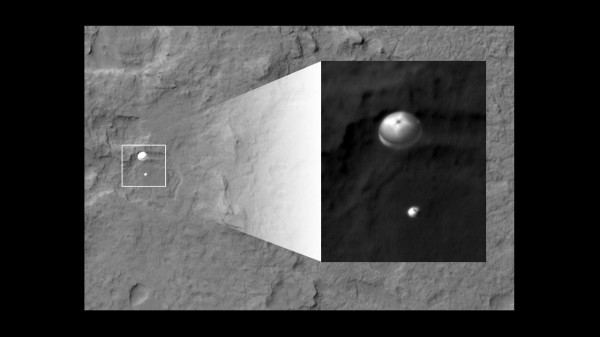
Curiosity actively used a massive, highly durable supersonic parachute to aggressively slow down rapidly during the high-speed landing. The completely new thing about the Curiosity landing was safely lowering the heavy rover directly onto the Martian surface by strong steel cables heavily with the direct help of a hovering rocket-powered sky crane. After the soft touch down, the hovering rocket rapidly flies away and safely crashes at a far distance.
Credits: NASA Mars Science Laboratory, Wikipedia, Twitter
Pingback: Amazing Mars Curiosity Descent Video from MARDI Images