Introduction
A Global Positioning System consists of three segments: the satellite constellation, the ground control network, and user equipment. A satellite constellation means a number of satellites in low Earth orbit that provide signals and navigation data to user equipment.
The ground control network tracks and maintains the satellite constellation by monitoring satellite health and signal and orbital configuration. User equipment receives the signal from satellites and computes the user’s position, velocity, and time (PVT).
A basic satellite constellation consists of 24 satellites positioned in 6 Earth-centred orbital planes, with four operational satellites and a spare satellite in each orbital plane. The satellite constellation can support up to 30 satellites in orbit.

The Master Control Station (MCS) is located at Schriever Air Force Base near Colorado Springs, Colorado. The Master Control Station commands and controls all the functions for the satellite network.
The orbital satellites are continuously tracked from 6 United States Air Force stations around the globe.
Since its development in 1960, the Global Positioning System has become an important tool for everything from defence to everyday life. The first GPS satellites were launched in 1978 by the U.S. Department of Defense.
Lockheed Martin built most of the GPS satellites for the Air Force. Lockheed Martin designed 21 GPS IIR satellites and modernised the GPS IIR-M. As technology evolves day by day, GPS users demand better services.
Current GPS devices often search for signals and have a hard time accessing the signal in mountainous and forest areas. GPS jamming is one of the problems the military is facing today.
GPS III: The Next Generation
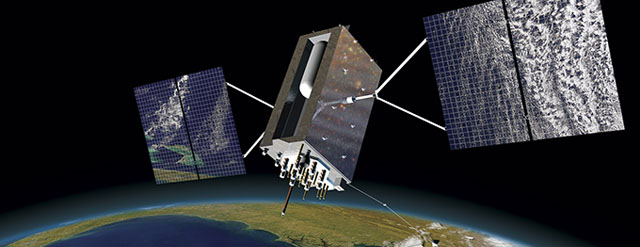
The next-generation GPS satellites are being built by Lockheed Martin. GPS III signals will be 3 times more accurate and powerful than the current generation. For the military, signals will be 8 times more powerful and thus resistant to signal jamming.
Improved Safety, Signal Integrity, and Accuracy
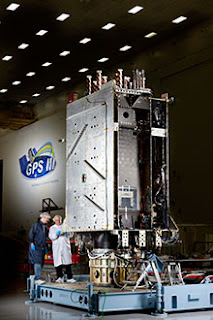
Users will get better accuracy from any region in the world. Lockheed Martin claims that the GPS III satellites will have a 15-year design life, which is twice the life of current satellites. The new GPS III satellites can be launched two at once, making them economical.
GPS III satellites cannot be easily jammed by accidental transmissions or by enemies. The military gets assured, full access to the GPS.
“GPS has become essential to almost all aspects of modern life,” said Lockheed Martin’s GPS III program manager Keoki Jackson.
“GPS III will ensure the availability of this critical utility with enhanced performance to billions of users worldwide for decades to come.”
Watch the video by Lockheed Martin on GPS Navigation:
Source: Lockheed Martin