Editor’s Note: This article was originally published in 2012, covering early research by MIT on three-dimensional solar panel configurations designed to maximise energy capture.
A team from the Massachusetts Institute of Technology (MIT) has developed innovative new 3D solar array structures that can double the solar power generated from a given area.
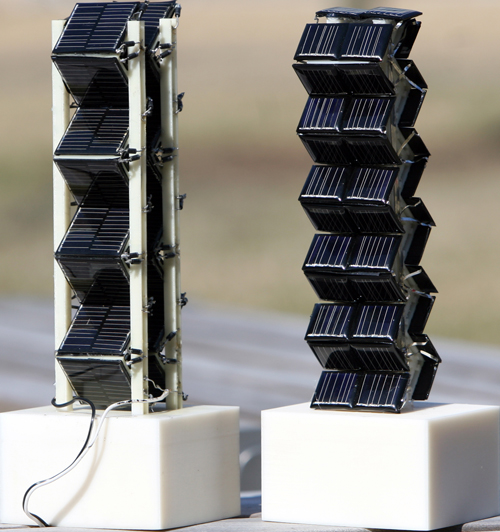
In a traditional solar panel, the cells are laid out flat on a substrate. But the MIT team came up with a very different approach by creating towers of solar cells in a three-dimensional configuration that they say can generate power output ranging from double to more than 20 times that of fixed flat panels with the exact same base area.
Harvesting More Sunlight
The major reason for the boost in performance is that the 3D structures’ vertical surfaces can harvest more sunlight in the mornings, evenings, and during winters when the sun is much closer to the horizon. This results in power that is more predictable and uniform, with the potential of making integration into the mains electricity grid far less complex than conventional systems.
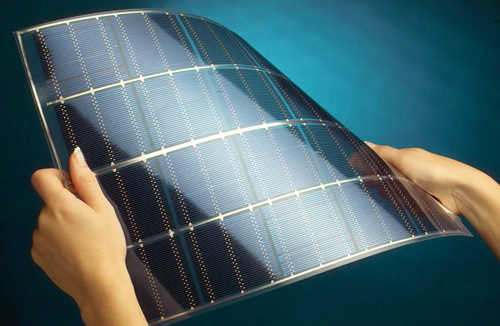
While the way the cells are arranged makes the unit more expensive to construct than a flat panel, the immense increase in power production could offset the initial cost. In relation to terrestrial based solar farms, it could also translate to generating the same amount of power from far less land, or significantly more electricity from the exact same footprint.
Commercial Applications
The challenge remains to mass produce the elements for the 3D design in a cost-effective manner. A commercial version of the towers would be one that could be shipped flat and then unfolded on-site. Such a tower could be installed in a parking lot to provide a highly efficient charging station for electric vehicles.
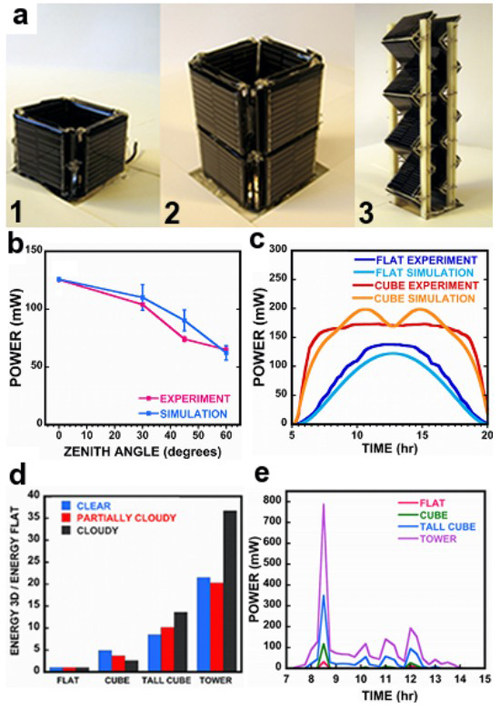
The MIT team initially used a computer algorithm to explore an enormous variety of possible configurations, and developed analytic software that can test any given configuration under a whole range of latitudes, seasons, and changing weather conditions. Then, to confirm their model’s predictions, they built and tested three different physical arrangements of solar cells on the roof of an MIT laboratory building for several weeks.
Uniform Power Output
While the cost of a given amount of energy generated by such 3D modules exceeds that of ordinary flat panels, the expense is partially balanced by a much higher energy output for a given footprint. It is also balanced by a much more uniform power output over the course of a day, over the seasons of the year, and in the face of blockage from scattered clouds or shadows.
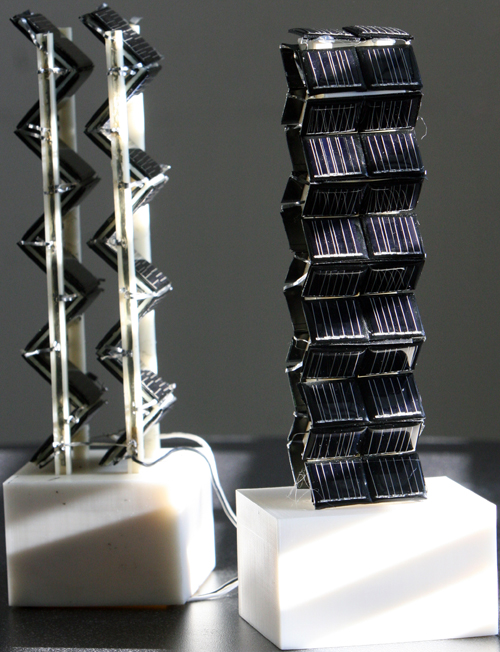
In general, 3D shapes could have a big advantage in any location where space is strictly limited, such as flat-rooftop installations or in dense urban environments. Such shapes could also be used in larger-scale applications, such as large solar farms, once shading effects between adjacent towers are carefully minimised.
So far, the team has modelled individual 3D modules. A next step is to study a large collection of such towers, thoroughly accounting for the shadows that one tower would naturally cast on others at different times of the day. The team’s findings have been published in the journal Energy and Environmental Science.