The Defence Advanced Research Projects Agency aims to develop a reusable hypersonic unmanned vehicle that can lower operational costs and make spacecraft more reliable.
With current satellite launch vehicles, it is expensive to operate them in each mission. They cost millions of dollars per flight and require advanced planning and allocation of resources for each mission.
Experimental Spaceplane (XS-1) Program
To counter those spaceflight challenges, DARPA has created this program which aims to develop a reusable unmanned space vehicle that can be operated like an aircraft to space. To make the operation clean and simple, there will only be a small ground crew to control the spacecraft.
They will be able to do daily operations and flights from various locations on our planet. With this simplicity and low costs, small satellites can be deployed easily in space.
To achieve this, the aircraft would require better thermal protection systems, recovery systems, and autonomous launch and flight systems.
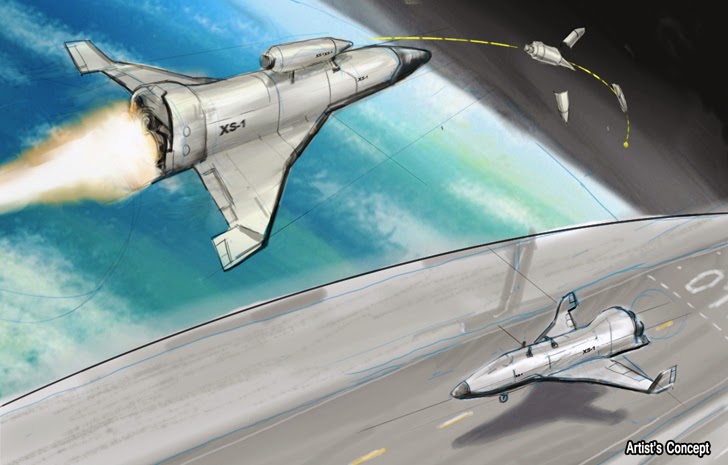
As you could see from the above artist’s conception, the reusable first stage will fly to hypersonic speeds at a suborbital altitude. Then the expendable stage separates and deploys a satellite into Low Earth Orbit. Then the hypersonic vehicle will safely return to earth for the next flight.
The aircraft would be able to do daily flights and reach speeds above Mach 10 and deliver payloads into orbit. The vehicle will enable delivery of payloads from 3,000 to 5,000 pounds. This will help reduce the cost of delivering small satellites into space.
Another DARPA program called Airborne Launch Assist Space Access (ALASA) plans to propel 100-pound satellites into orbit for less than 1 million dollars per launch.
DARPA is seeking ideas and proposals for developing and implementing the XS-1 program. The DARPA Special Notice about specific capabilities of the program is now available at http://go.usa.gov/DNkF.
Source: DARPA