Editor’s Note: This article was originally published in 2012 during the early dawn of wearable tech and smart glasses, long before devices like the Apple Vision Pro or Meta Ray-Bans were commonplace. It has been preserved and updated to reflect the historical significance of early innovations like Pivothead.
Back in the early 2010s, the idea of photographers being able to digitally record their own visual world hands-free was revolutionary. Pivothead was one of the early innovators, launching sunglasses with built-in video cameras designed to protect your eyes while seamlessly recording daily life.

Groundbreaking Features for 2012
For its time, Pivothead packed an impressive amount of hardware into a sleek sunglass frame:
- A 44.1 kHz microphone for clear audio capture.
- Gyroscopic Image Stabilisation to reduce motion blur.
- Continuous Auto-focus (when in “Active Mode”).
- Video shot at 30fps in either 1080p or 720p (or 60fps at 720p), saved in H.264/MPEG-4 format.
- An 8-megapixel still camera utilising a Sony CMOS sensor (the same highly regarded sensor type used in the iPhone 4 and 4S).
- Specialised modes including “Spectator Mode,” “Social Mode,” and “Black & White Mode.”
- Burst modes capable of taking up to 16 stills in rapid succession, plus time-lapse options.
- Up to two hours of continuous recording per charge.
- High-grade lenses featuring anti-scratch, anti-reflection, and hydrophobic coatings.
How They Worked
Users could simply wear the Pivothead glasses as regular sunglasses. When it was time to record, the camera was activated by tapping a button on the bottom of the left side. Pushing a top button initiated recording in the default 1080p mode.
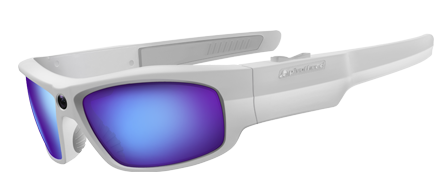
Adjusting the settings required holding down specific button combinations, a common interface design reminiscent of digital sports watches of the era. Small LEDs on the interior of the left arm provided visual feedback to the wearer.
Critical Reception and Legacy
The Pivothead Video Recording Eyewear won enthusiastic endorsements at events like the Winter Outdoor Retailer Market Trade Show in Salt Lake City in 2011. The sleek, high-definition glasses even won the “In-New-Vation” award sponsored by 3M, beating out numerous competitors.

“The focus is on quality,” inventor and Colorado native Christopher Cox noted at the time. The expert panel evaluated the glasses on innovation, functionality, usefulness, and design, praising them for being lightweight and comfortable.
Originally shipping in April 2012 at a retail price of $349, Pivothead helped pave the way for the massive wearable tech industry we have today, proving there was a real consumer appetite for point-of-view, hands-free video recording.
