Editor’s Note: This article was originally published in June 2012, covering the successful maiden flight of Boeing’s hydrogen-powered Phantom Eye UAV.
Yet another groundbreaking technological innovation has proudly emerged from The Boeing Company. Boeing’s entirely new Phantom Eye is an advanced unmanned airborne vehicle (UAV) designed specifically for extreme high altitude and incredibly long endurance (HALE) missions.
It is a highly innovative, hydrogen-powered spy plane that effectively serves as an unwavering eye in the sky for crucial military surveillance, rapid disaster relief, critical search and rescue operations, and for numerous other civilian uses.
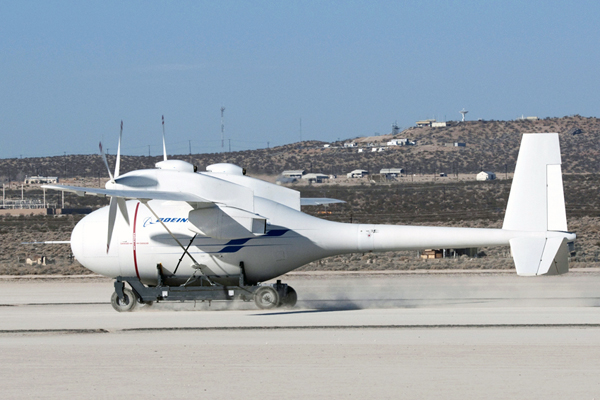
The Phantom Eye Unveiled
The state-of-the-art UAV is meticulously developed by the renowned Boeing Phantom Works, which is a main aerospace defence and high security division of the massive Boeing company. Programme manager Drew Mallow confidently talks about the revolutionary spy plane in the informative video below.
Phantom Eye is uniquely designed to reliably provide highly advanced military intelligence and persistent reconnaissance across various difficult combat conditions. Phantom Eye has heavily evolved from the earlier piston-powered Boeing Condor, which was a massive high altitude, long endurance spy drone rapidly developed in the late 1980s.
Incredible Endurance and Stealth
The impressive Phantom Eye demonstrator has a massive, glider-like wingspan of 46 metres (150ft) and can steadily fly continuously for more than four solid days at incredible altitudes of up to 65,000 feet. Boeing proudly says that the large aircraft is fully capable of securely carrying 450 pounds of sensitive payload with an average cruise speed of roughly 150 knots.
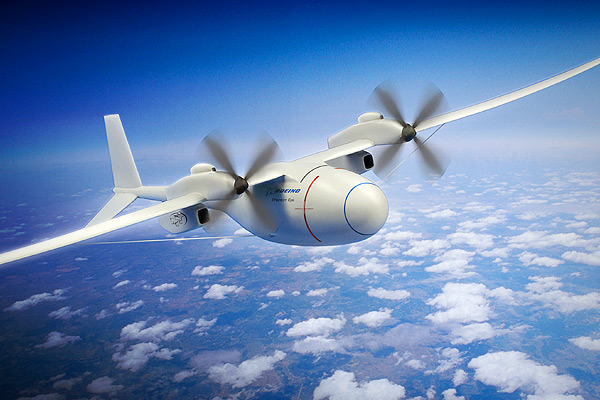
You can clearly see from the official images that the Phantom Eye visibly has absolutely no heavy armament. It is explicitly specialised mainly for the peaceful gathering of surveillance and critical intelligence data.
The Successful First Flight
After many long, difficult months of intense technological development, Boeing’s Phantom Eye incredibly successfully completed its very first major flight test on June 1 at NASA’s prestigious Dryden Flight Research Center located at Edwards Air Force Base in California.
The short, cautious 28-minute test flight actively began at exactly 6:22 a.m. Pacific time as the large Phantom Eye smoothly lifted off from the long runway. It safely climbed to a steady altitude of 4,080 feet while maintaining a slow cruise speed of 62 knots.
Green Technology and the Future
This highly successful first flight firmly puts Boeing on a clear, confident path to successfully accomplish another absolute first in aerospace capability: an incredible four straight days of entirely autonomous flight without ever needing dangerous mid-air refuelling.
With its excellent first flight which flawlessly demonstrated fantastic initial handling and superb manoeuvrability, the dedicated engineering team is now rigorously analysing the vital mission data and carefully preparing for the next major test flight.
Phantom Eye’s incredibly environment-friendly liquid-hydrogen propulsion system primarily consists of modified Ford 2.3-litre combustion engines, a complex reduction gearbox, and a massive 4-blade propeller. These custom engines feature a highly complex multiple turbocharger system that rapidly compresses low-density, thin mountain air and drastically reduces the massive infrared heat signature, effectively making the large drone much more stealthy during a combat flight.
The aircraft is incredibly highly economical and genuinely “green,” as pure liquid water is the absolutely only chemical byproduct actively produced as a result of the hydrogen propulsion. This single fact makes Boeing’s Phantom Eye a truly great environmental innovation.